The cross-modality survival prediction method of glioblastoma based on dual-graph neural networks
Abstract
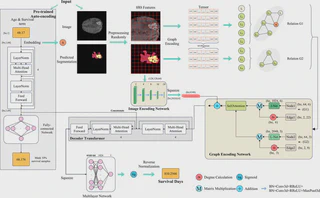
Glioma, the highly lethal malignant brain tumor originating from abnormal proliferation of glial cells, exhibits a varied overall survival rate influenced by multiple factors. Accurate prediction rate of survival periods assist physicians in selecting the most suitable treatment plans to improve patient overall survival (OS) rates. The paper proposes a dual-graph neural network (GNN) with manually constructed feature relational graph for OS prediction and inference of different survival periods in glioblastoma based on cross-modality data. Specifically, five radiomic features from magnetic resonance imaging are extracted to construct two sets of feature relational graphs. The main GNN is utilized to extract comprehensive features, including age, brain MRI features, and radiomics features of gliomas. The branch GNN additionally extracts radiomics features specific to gliomas, constraining the feature weights of the main GNN through attention mechanisms. Pretraining an autoencoder to extract deep features from patient text information. The text features and image features are then reorganized based on features from different modalities through a transformer decoder. Finally, a multi-layer perceptron is utilized for regression and classification, thus enabling the classification and prediction of patient survival. The proposed method achieved an accuracy of 0.586 for classifying and predicting the survival of glioma patients in the short, medium, and long term on the BraTS20 dataset, outperforming state-of-the-art methods.
Type
Publication
Expert Systems with Applications